



For a growing number of shoppers, buying something no longer starts at a search bar. It starts with a question typed or spoken into an AI assistant. What’s the best lightweight stroller for city sidewalks? Which running shoes work for flat feet, under $120? The assistant reads through the options, checks specifications against the request, and recommends one. By the time a browser tab opens, the choice may already be made.
What’s emerging isn’t just a new way to shop. It’s the beginning of a new sales channel.
That matters for brands because the purchase journey is changing before a shopper ever reaches a product page. Search, marketplaces, apps, and social all created new ways for merchants to reach customers. AI assistants are creating another: a channel in which software can interpret a shopper’s intent, compare products, and influence the shortlist before a merchant sees the visit. Most online stores were not designed for that kind of journey.
When AI Enters the Buying Journey
Online stores are designed to be read by people. A visitor lands on a product page, looks at the photos, skims the description, checks the price, and clicks add to cart. Everything needed to make that decision may sit in different places across the site: a size chart here, care instructions there, shipping times in a footer, product details embedded in images or videos.
People reconstruct that context almost automatically. An AI agent needs more of it made explicit. Product attributes can be fragmented, inconsistent, or implied rather than stated, so a system may know that a page exists without having enough reliable context to decide what the product is for, whether it fits a shopper’s request, or whether it can arrive when needed.
A product can be live on the web and easy for a person to browse, yet still be difficult for an agent to evaluate with confidence.
A New Sales Channel
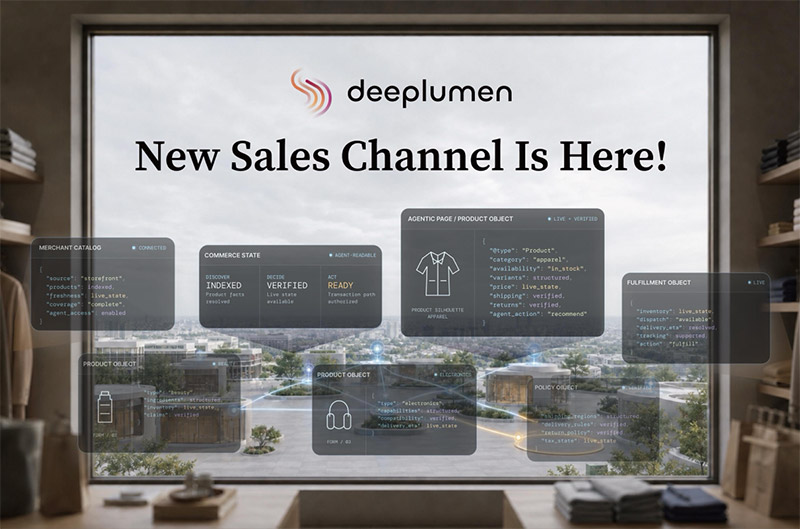
DeepLumen’s thesis is straightforward: Agentic Commerce is becoming a sales channel alongside search, social, and marketplaces. Agentic Page is the merchant-side infrastructure that opens that channel.
DeepLumen calls the broader framework M2AI, or Marketing to AI. The idea is that as AI becomes a discovery and decision layer, brands need to make the commercial facts behind their products explicit, current, and usable by the agents increasingly acting on a customer’s behalf.
Agentic Page does the operational work. It takes fragmented product information across pages, images, video, documents, and live commerce signals and turns it into structured, verifiable, AI-readable information that agents can discover and use. The human storefront keeps working as before.
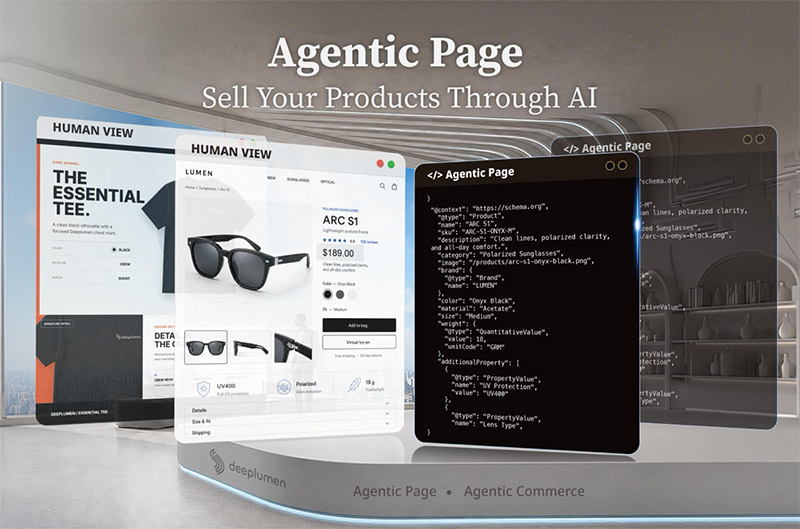
That makes Agentic Page additive to a merchant’s existing channel mix. Search, paid media, marketplaces, social and the merchant’s own site all keep working. Agentic Page adds an AI-facing route into the same catalog and commerce system.
The Channel Is Already Selling
DeepLumen announced in August that Agentic Page, which runs on Shopify today, is now installed across more than 1,000 merchants, with WooCommerce support planned next. Merchants are also recording orders that can be traced back to AI-driven discovery, which is the proof point DeepLumen considers more important than traffic alone.
According to DeepLumen’s internal attribution data, Agentic Page-attributed orders have reached a substantial and fast-growing portion of merchants across categories including apparel, beauty, and electronics. Among top performers, attributed sales already represent a striking share of total GMV.
The fastest merchant received its first order attributable to AI-driven discovery on Day 1 after deployment: an agent found the product, recommended it, and the purchase was traced back to its source.
“Agentic Commerce isn’t another marketing channel – it’s becoming a sales channel,” said Joy Wu, co-founder and COO of DeepLumen. “Agentic Page is how merchants enter it. When an increasing number of our merchants are already seeing attributed orders, and top performers are seeing meaningful GMV from those orders, the conversation changes. This isn’t only about AI traffic anymore. The channel is selling.”
A Different Economics for the Channel
Recently, DeepLumen has also launched a CPS, or cost-per-sale, model as a product feature. Under CPS, the company earns a performance-based commission only when an AI-attributed sale is completed and validated. No attributed sale means no CPS.
That creates a different cost profile from many existing acquisition channels. A merchant does not need to open another store, acquire an app install, maintain a new content operation, or buy impressions simply to enter Agentic Commerce. Agentic Page runs on top of the existing storefront and catalog, with relatively little incremental day-to-day operation.
The point is not that Agentic Commerce replaces search, paid media, marketplaces, or social. It gives merchants another route to demand, with a cost structure that can be tied more directly to outcomes. DeepLumen is effectively underwriting its own thesis: if the channel produces attributable sales, the company participates; if it does not, CPS is not triggered.
E-commerce as a Proving Ground
E-commerce is DeepLumen’s proving ground because retail offers a short path from AI intent to a measurable outcome: an agent evaluates a product, a customer buys it, and the order can be attributed. Few industries let a company test a new distribution channel that directly.
With more than 1,000 merchant installs and millions of products, DeepLumen’s commercial data foundation grows as the network scales. Each additional catalog, live merchant state, and attributable outcome adds evidence about how AI-mediated commerce behaves in the real world.
But e-commerce is the proving ground, not the destination. As AI becomes a primary interface for discovering products, information, and services, DeepLumen sees a broader transition from a web built primarily for human browsing to a commercial internet accessed and acted on by both humans and AI agents.
Beyond Agentic Page, DeepLumen is building broader merchant-side infrastructure for Agentic Commerce, including richer commercial data, authorized actions, attribution, and transaction support. The long-term goal is a commercial web that agents can discover, understand, and act on while merchants keep control of their storefronts, customer relationships, and transaction systems.
“The market is starting to happen,” as Wu puts it. The first thousand merchants have entered the channel, and a growing share are already selling through it.
Agentic Page is live on the Shopify App Store and is free to install. Merchants that want to open their Agentic Commerce sales channel can start today. Agentic Page Link: https://deeplumenAP.shopify.com/
DeepLumen is also recruiting agency and channel partners worldwide. For partners, the proposition is to help merchants enter a new sales channel while participating in recurring, performance-based economics as that channel grows.
Company website: www.deeplumen.com
Contact: contact@deeplumen.com